

How a subscription model replaced $80K–$500K of annual validation overhead—and why that matters more than ever in 2026
In Part 1, I described the architectural problem that led to ProcessX: IT Quality operating in the wrong systems, creating over $1.5M per year in hidden operational waste.
But solving that problem exposed something else.
Even with the right architecture, organizations were drowning in a different kind of friction: the relentless pace of SaaS releases.
Every major platform in life sciences—Veeva, DocuSign, Box, Oracle, Salesforce, ServiceNow—releases updates constantly. Monthly patches. Quarterly features. Semi-annual upgrades. And each release triggers the same painful question: “Do we need to validate this again?”
For regulated companies, that question sets off a cascade of manual work: impact assessments, test script execution, traceability updates, validation reports, and approvals. Over and over.
For every system. Every release.
What many organizations underestimate is the sheer scale of this burden. A single platform like Veeva can consume $80,000–$150,000 per year in internal validation effort—and that’s an estimate based on the extensiveness of configuration and customization; Veeva Essentials implementations typically cost less, while organizations with multiple Vaults or complex configurations trend higher. Oracle Clinical One? $180,000–$420,000. Multiply across a dozen validated systems, and the cost becomes staggering.
This realization led to Cloud Assurance—a fundamentally different model for managing GxP SaaS validation.
The SaaS Validation Treadmill: Why Every Company Repeats the Same Work
When I started analyzing how life sciences companies manage SaaS releases, I kept seeing the same pattern:
- Every company repeating the same work. Veeva releases an update. 500 pharmaceutical companies independently analyze the same release notes, execute similar tests, and produce parallel validation reports.
- Highly skilled teams doing low-value work. Senior validation specialists spending 60% of their time proving that systems still work exactly the way they worked yesterday.
- Reactive instead of predictive. Teams discover issues after deployment because they don’t have real-time intelligence about vendor behavior, security posture, or release patterns.
- No institutional memory. Each release cycle starts fresh. Lessons learned from the last validation don’t inform the next one.
This isn’t validation. It’s a compliance tax—and it’s paid by every regulated company, every year, for every system.
The question became obvious: What if companies didn’t have to repeat this work at all?
Traditional Managed Services vs. Cloud Assurance: Two Fundamentally Different Models
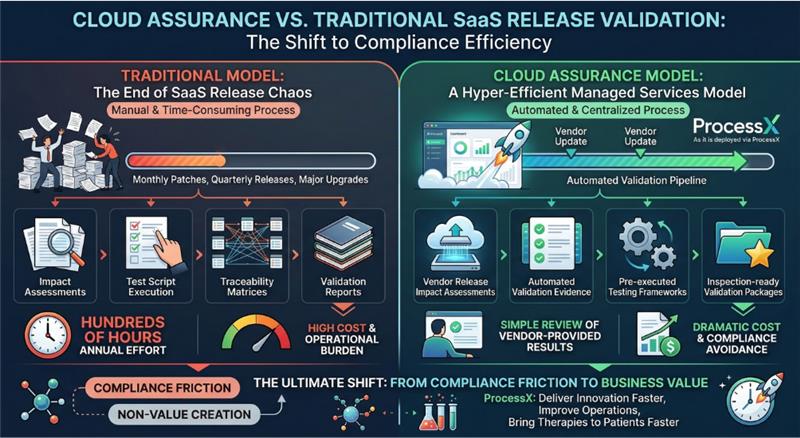
Most organizations address SaaS validation burden through one of two approaches:
Approach 1: Internal Teams (The Treadmill)
Build an internal team to manage ongoing validation. This works—until you calculate the true cost:
Annual Internal Validation Cost by Platform
| Platform | Releases/Year | Internal Cost (Low) | Internal Cost (High) |
|---|---|---|---|
| Veeva Vault * | 3 | $80,000 | $150,000 |
| Oracle Clinical One | 3 | $180,000 | $420,000 |
| DocuSign | 12 | $50,000 | $90,000 |
| Box | 4 | $40,000 | $80,000 |
| Salesforce | 3 | $70,000 | $120,000 |
| SAP | 2 | $200,000 | $400,000 |
| ServiceNow / ProcessX | 2 | $60,000 | $120,000 |
| AWS / Azure | 4–6 | $60,000 | $200,000 |
* Veeva costs vary significantly based on configuration complexity and number of Vaults. Essentials implementations trend toward the lower range; organizations with multiple Vaults, extensive customization, or complex integrations trend higher. Source: USDM client engagements and Board Verification Report benchmarks
For a mid-sized pharma with 8–10 validated SaaS platforms, internal validation can easily exceed $600,000–$1.2M annually—and that’s just the ongoing work, not counting initial validation or major upgrades.
Approach 2: Traditional Managed Services (Outsourced Treadmill)
Hire a consulting firm to manage validation on your behalf. This shifts the labor burden, but it doesn’t solve the fundamental problem:
- Reactive engagement model. Managed services wait for releases, then mobilize. There’s no proactive intelligence about what’s coming or what it means.
- Per-project economics. Every release is a new project with new scoping, new contracts, and new mobilization overhead.
- Limited knowledge transfer. The consultant’s expertise walks out the door when the engagement ends. Your team is no smarter than before.
- No cross-client learning. The firm might serve 50 pharma clients, but insights from one engagement don’t systematically inform another.
Traditional managed services are essentially outsourced treadmills. The model scales linearly with effort—which means costs scale linearly too.
Cloud Assurance: A Different Architecture Entirely
Cloud Assurance is built on a different principle: What if validation intelligence could be shared?
Instead of 500 companies independently analyzing the same Veeva release, what if that analysis happened once—by experts who understand both the platform and regulatory requirements—and the results were delivered to all subscribers?
This is the Cloud Assurance model:
The Three-Leg Stool
 Validated Expertise Validated Expertise |
 Continuous Intelligence Continuous Intelligence |
 Subscription Coverage Subscription Coverage |
|---|---|---|
| Deep GxP knowledge across 25+ platforms. USDM understands what FDA inspectors look for—before the vendor does. | Every vendor release monitored. Every deviation caught. Every client alerted before impact. Real-time cyber posture via Black Kite. | Instead of per-project engagement, subscribe to continuous coverage. Releases arrive pre-analyzed with evidence ready to review. |
Remove any leg and the model fails. Expertise without coverage creates gaps. Coverage without intelligence misses risks. Intelligence without expertise misreads signals.
How Cloud Assurance Actually Works: Traditional vs. Proactive Workflow
When a vendor releases an update, the Cloud Assurance workflow looks fundamentally different from traditional approaches:
Traditional Workflow (Reactive)
1. Vendor announces release → 2. Client discovers release (often late) → 3. Client assembles team → 4. Team analyzes release notes → 5. Team writes impact assessment → 6. Team executes tests → 7. Team documents results → 8. Client reviews and approves → 9. Release deployed
Time: 2–4 weeks. Effort: 40–120 hours per release.
Cloud Assurance Workflow (Proactive)
1. USDM receives early access to release notes → 2. Change auto-created in ProcessX VLM → 3. AI-assisted impact assessment drafted → 4. Expert review and testing completed → 5. Validation package delivered to subscriber → 6. Client reviews pre-executed evidence → 7. Client approves with e-signature → 8. Release deployed
Time: Days (not weeks). Effort: 4–8 hours of client review.
Cloud Assurance Deliverables: What You Actually Receive
For each vendor release, Cloud Assurance subscribers receive:
- Release Impact Assessment — AI-assisted analysis of release notes, mapped to your URS/FRS/Risk matrix
- Pre-executed Test Evidence — Risk-based testing completed by USDM experts
- Traceability Updates — Requirements → Tests → Results linked and audit-ready
- Validation Report — Inspection-ready documentation with Part 11 compliant approvals
- Deviation Alerts — Any identified issues flagged with recommended remediation
- Cyber Posture Updates — Black Kite integration provides continuous vendor security monitoring
- Annual Vendor Audit — Comprehensive supplier qualification audit conducted annually for each subscribed vendor, including audit report, findings summary, and CAPA tracking integration with ProcessX
Everything flows directly into the ProcessX Validation Lifecycle Management (VLM) module—creating a single, immutable record of system state.
Annual Vendor Audit: Supplier Qualification Without the Overhead
One of the most resource-intensive compliance requirements is annual supplier qualification audits. For GxP-critical SaaS vendors, organizations must demonstrate ongoing oversight—which traditionally means:
- Scheduling and coordinating audits with each vendor
- Deploying internal QA resources (often 40–80 hours per vendor)
- Travel costs for on-site audits
- Audit report writing and CAPA follow-up
- Evidence management across disparate systems
Cloud Assurance includes Annual Vendor Audits as a standard deliverable for each subscribed platform:
What’s Included in the Annual Vendor Audit
- GxP-focused audit scope — Covering data integrity, change control, security, incident management, and business continuity
- Audit conducted by USDM SMEs — Auditors with deep platform expertise and regulatory background
- Comprehensive audit report — Executive summary, detailed findings, risk classification, and recommendations
- Findings integration — Any audit observations auto-create CAPA/change records in ProcessX with owners, due dates, and SLA tracking
- Vendor response tracking — USDM follows up with vendors on corrective actions; closure evidence flows into your system of record
- Inspection-ready documentation — Complete audit package available for regulatory inspection with <1 hour export
Instead of managing 8–12 separate vendor audit cycles internally, Cloud Assurance subscribers receive audit coverage as part of their subscription—with all evidence already linked in ProcessX VLM.
Integration with ProcessX VLM: The Single Source of Truth
Cloud Assurance isn’t a standalone service—it’s designed to integrate directly with ProcessX VLM.
When a Cloud Assurance package arrives:
- A change record is auto-created with the vendor release details, impact assessment, and testing artifacts
- The traceability matrix updates automatically—linking URS → FRS → Risk → Test → Result → Approval
- System status updates in real-time on the Compliance Dashboard
- Part 11 electronic signatures capture approvals with identity, timestamp, and meaning
- The audit trail records every action, creating inspection-ready evidence
This means organizations maintain a continuous validation state across all subscribed platforms—without the manual effort of assembling evidence after each release.
The Inspection-Ready Promise
When an FDA investigator asks for “the validation package for your latest Veeva release,” organizations with Cloud Assurance + ProcessX VLM can:
- Export a complete inspection pack in less than 1 hour
- Show linked requirements, risks, tests, and approvals in a single view
- Demonstrate continuous compliance rather than point-in-time validation
- Provide cyber posture evidence showing ongoing vendor security monitoring
- Present annual vendor audit reports with CAPA closure evidence
No more archaeology in SharePoint. No more “let me get back to you on that.” The evidence exists, it’s linked, and it’s ready.
The Value: Cloud Assurance vs. Internal Validation
The economics are compelling—and this is real data from 150+ active Cloud Assurance contracts:
|
Platform |
Internal Cost (Est.) | Annual Savings with Cloud Assurance | ROI with Cloud Assurance |
| Veeva Vault * |
$80K–$150K |
$35K–$105K | 78%–233% |
| Oracle Clinical One |
$180K–$420K |
$128K–$368K |
246%–708% |
| DocuSign |
$50K–$90K |
$30K–$70K |
150%–350% |
|
Box |
$40K–$80K | $3K–$43K |
8%–116% |
|
Salesforce |
$70K–$120K | $46K–$96K |
192%–400% |
|
SAP |
$200K–$400K | $115K–$315K |
135%–371% |
|
ServiceNow / ProcessX |
$60K–$120K | $18K–$78K |
43%–186% |
* Veeva internal costs are estimates that vary significantly based on configuration extensiveness, customization complexity, and number of Vaults. Organizations with Veeva Essentials or minimal customization typically fall at the lower end; those with multiple Vaults, complex integrations, or extensive configuration trend toward the higher range.
Source: USDM Cloud Assurance Value Intelligence · 146 contracts · February 2026
Risk Avoidance Value
Cloud Assurance’s continuous monitoring catches deviations before they become audit findings. Based on industry benchmarks (2.1 deviations caught per release average), the FDA risk avoidance value ranges from:
- Veeva: $500,000 potential remediation cost avoided
- Oracle Clinical One: $900,000 potential remediation cost avoided
- SAP: $800,000 potential remediation cost avoided
A single avoided 483 observation can pay for years of Cloud Assurance coverage.
Why This Matters More Than Ever in 2026
Several trends are making Cloud Assurance increasingly essential:
- Accelerating release cadences. Vendors are shipping faster than ever. Veeva used to release 2x/year; now it’s 3x. DocuSign ships monthly. AWS releases continuously. The validation burden is growing, not shrinking.
- AI-generated content scrutiny. Regulators are asking harder questions about how AI is used in validation. Cloud Assurance provides governed AI with clear audit trails—showing what was drafted, by whom, and how it was reviewed.
- Third-party risk intensification. CRO breaches, vendor security incidents, and supply chain attacks are accelerating. Cloud Assurance’s Black Kite integration provides continuous cyber posture monitoring across all subscribed vendors.
- Inspection expectations rising. FDA and EMA increasingly expect real-time traceability, not point-in-time validation snapshots. Organizations with continuous compliance posture are better positioned for unannounced inspections.
- Skilled resource scarcity. Senior validation professionals are in high demand. Cloud Assurance lets organizations leverage USDM’s expertise rather than competing for scarce internal talent.
Getting Started: The Cloud Assurance Onboarding Model
Cloud Assurance implementation follows a structured onboarding process:
Phase 1: Discovery (2–4 weeks)
- Inventory of validated SaaS systems and current validation approach
- Gap analysis against Cloud Assurance coverage
- ProcessX VLM configuration requirements
- Pricing and subscription scoping
Phase 2: Onboarding (4–8 weeks per platform)
- URS/FRS/Risk matrix configuration in ProcessX VLM
- Baseline validation documentation migration
- Release monitoring activation
- Black Kite cyber monitoring enrollment
- Annual vendor audit scheduling
- Team training on Cloud Assurance workflow
Phase 3: Steady State (Ongoing)
- Release packages delivered per subscription
- Continuous intelligence updates
- Annual vendor audits conducted per platform
- Quarterly business reviews with value metrics
- On-demand inspection support
Most organizations achieve full steady-state operation within 3–6 months of initial engagement.
Summary: Traditional vs. Cloud Assurance
| Dimension | Traditional Approach | Cloud Assurance |
|---|---|---|
| Engagement Model | Per-project or FTE-based | Subscription coverage |
| Release Intelligence | Reactive (after announcement) | Proactive (early access) |
| Impact Assessment | Client creates from scratch | AI-assisted, pre-drafted |
| Testing | Client executes 100% | USDM executes, client reviews |
| Documentation | Manual assembly | Auto-generated, linked |
| Time per Release | 2–4 weeks | Days |
| Client Effort | 40–120 hours | 4–8 hours review |
| Vendor Audits |
Client manages internally | Included annually per platform |
| Cyber Monitoring | Point-in-time or none | Continuous (Black Kite) |
| InspectionReadiness | Manual pack assembly | <1 hour export |
| Cross-Client Learning | None | Systematic intelligence sharing |
Frequently Asked Questions
What is Cloud Assurance?
Cloud Assurance is a subscription-based validation service for GxP SaaS platforms. Instead of every company independently validating each vendor release, USDM performs the analysis, testing, and documentation once—and delivers inspection-ready packages to all subscribers. It includes release validation, continuous cyber monitoring, and annual vendor audits.
Which platforms does Cloud Assurance cover?
Cloud Assurance covers 25+ platforms commonly used in life sciences, including Veeva Vault (all editions), Oracle Clinical One, DocuSign, Box, Salesforce, SAP, ServiceNow/ProcessX, AWS, Azure, and others. Contact USDM for the complete coverage list.
How does Cloud Assurance pricing work?
Cloud Assurance is priced as an annual subscription per platform. Pricing varies based on release frequency, configuration complexity, and scope of coverage. For platforms like Veeva, costs depend on the number of Vaults and extent of customization—Essentials configurations typically cost less than enterprise implementations with multiple Vaults.
Does Cloud Assurance include annual vendor audits?
Yes. Each Cloud Assurance subscription includes an annual GxP-focused supplier qualification audit for that vendor. The audit covers data integrity, change control, security, incident management, and business continuity. Audit findings auto-create CAPA records in ProcessX with owner assignment and SLA tracking.
How does Cloud Assurance integrate with ProcessX?
Cloud Assurance is designed to integrate directly with ProcessX VLM (Validation Lifecycle Management). When release packages arrive, change records are auto-created, traceability matrices update automatically, and Part 11 electronic signatures capture approvals. All evidence flows into a single system of record.
What if my company doesn’t use ProcessX?
Cloud Assurance can deliver validation packages to organizations without ProcessX, though the integration benefits (auto-created records, traceability updates, single source of truth) require the ProcessX platform. Many organizations adopt ProcessX alongside Cloud Assurance for maximum value.
How quickly can Cloud Assurance be implemented?
Most organizations achieve full steady-state operation within 3–6 months. Discovery takes 2–4 weeks, and onboarding runs 4–8 weeks per platform. Organizations can begin receiving release packages for initial platforms while onboarding additional systems.
Coming Next: Agentic AI in Regulated Environments
Cloud Assurance solves the SaaS release validation problem. But there’s another frontier emerging: how do you govern AI agents in regulated environments?
In Part 3, we’ll explore how organizations are deploying agentic AI—AI that can take actions, not just generate text—while maintaining the controls that regulators require. Topics include:
- Governed AI vs. Shadow AI: Why the distinction matters for compliance
- AI drafting with human approval: The emerging standard for regulated content
- ProcessX AI Agents: How we’re building GxP-aware automation
- The regulatory landscape: What FDA and EMA are saying about AI in quality systems
The organizations that figure out AI governance first will have a significant competitive advantage. The ones that don’t will be playing catch-up—or worse, explaining their approach to investigators.
Ready to End the SaaS Validation Treadmill?
If you’re interested in learning more about Cloud Assurance or seeing how it might apply to your organization’s validated SaaS portfolio, I’d welcome the conversation.
Explore the full ProcessX series:
- Part 1: The $1.5M IT Quality Problem
- Part 2: Cloud Assurance — This article
- Part 3: Agentic AI in Regulated Environments
Related Resources
About the Author
Vega Finucan is a Co-Founder at USDM Life Sciences, where she focuses on building AI-enabled workflow solutions for regulated life sciences environments. ProcessX and Cloud Assurance were born from the patterns she observed across hundreds of pharmaceutical and biotech organizations—and from a persistent belief that compliance shouldn’t be a tax on innovation.


